NEWS
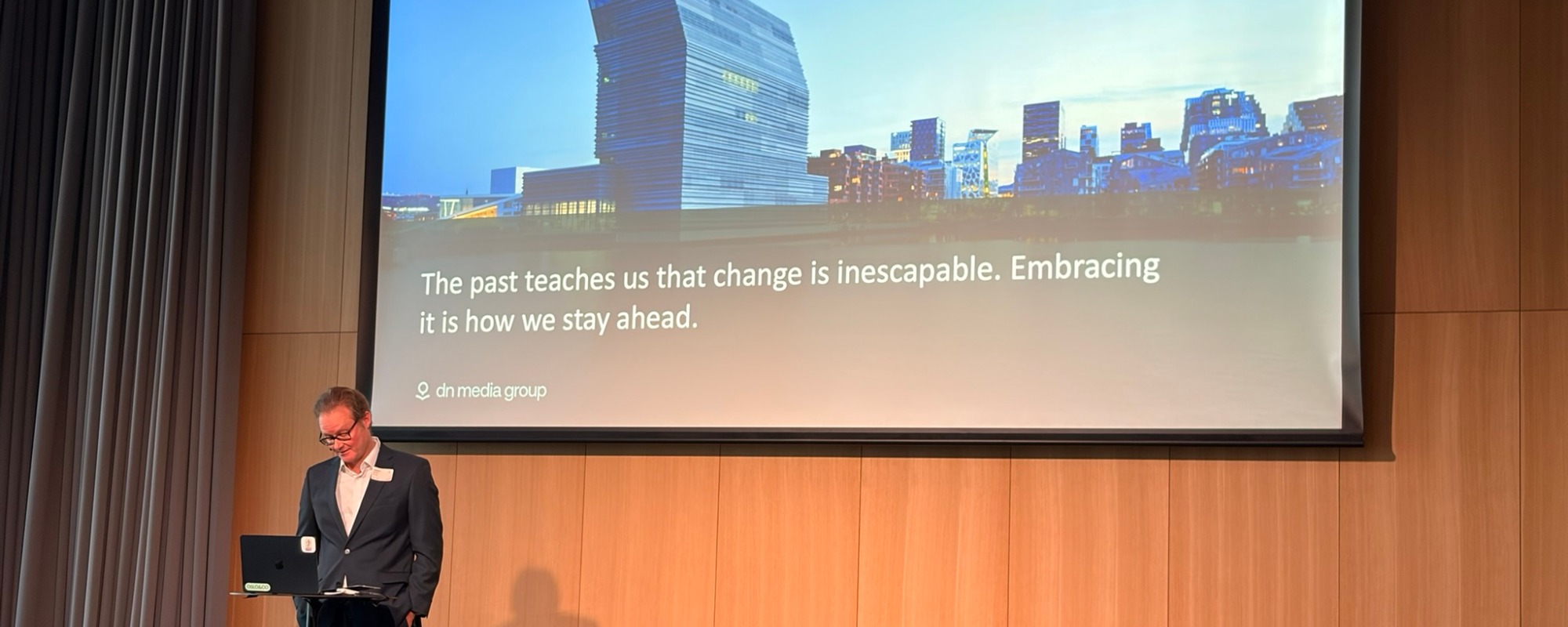
James Lamont, Chief Executive Officer of DN Media Group, told Oslo business leaders what drew him to the city after 25 years at the Financial Times, and what Oslo needs to do to win talent and capital.
4 min read
James Lamont said Oslo has far more international potential than it realises, and that it will realise it only if it chooses to compete.
Lamont spoke at Topplederforum Oslo, which he described as the first of its kind, at the invitation of the City Council and Oslo&Co. He was asked to share his first impressions after six months of full-time work in the city, and to explain why he chose Oslo as an international media executive.
Why Oslo
Lamont left a 25-year career at the Financial Times, where he was Managing Editor for eight years and responsible for 650 journalists in 33 countries, to move to Oslo. Three things attracted him: “a world-class company, a highly-trusted society, and a city with far greater international potential than it realises.”
He traced the first of those back to the founding of DN Media Group in 1889, in the New York Yacht Club, by Norwegian ship-owning families. Many of those families remain on the shareholder register, which Lamont called “an example of long-term patient capital.” The newspaper’s founding mission was to argue for better terms for Norwegian seafarers, so that crews did not leave for British and American competitors.
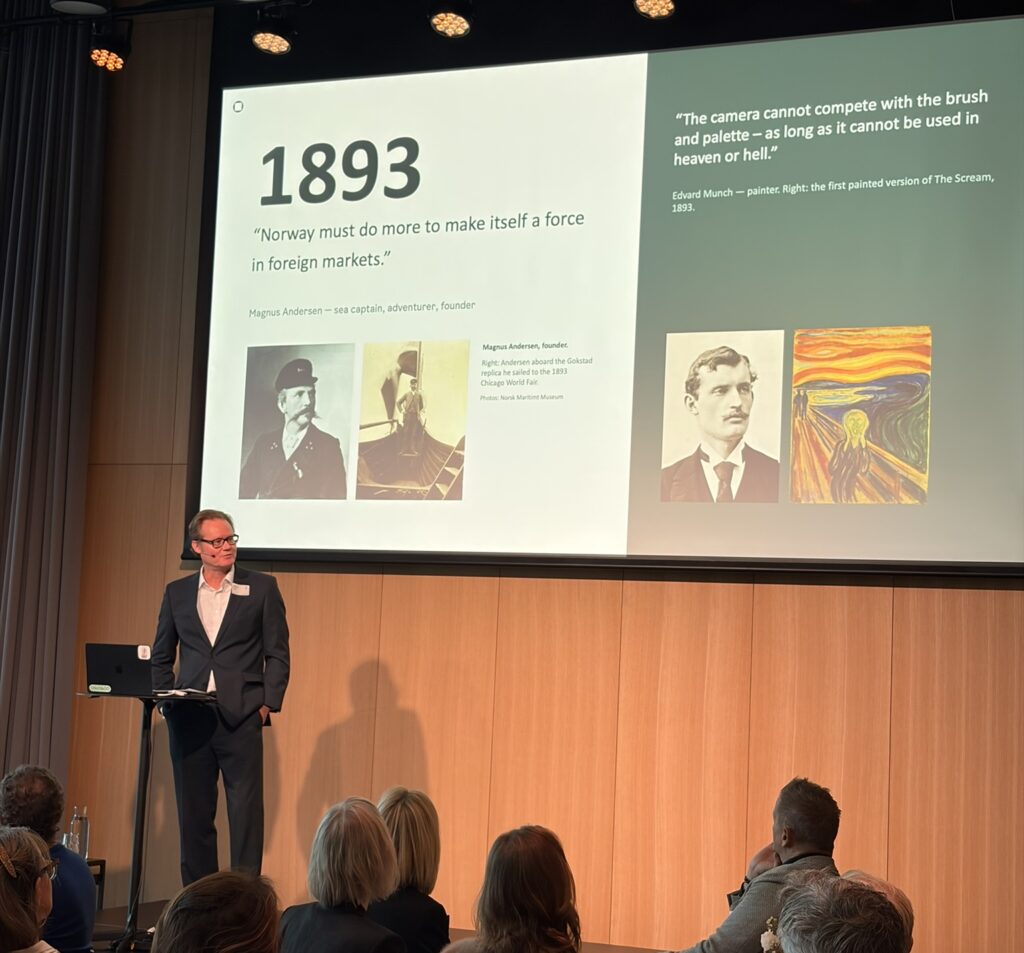
The first editor, Magnus Andersen, sailed a replica Viking boat from Norway to the World Fair in Chicago in 1893, the year Edvard Munch painted the first version of “The Scream”. Lamont drew a parallel with the present. Steam and iron were then overtaking sail, as AI is now changing the industries his audience leads. “But then as now, the advantage lies in human leadership and ecosystems of innovation and excellence,” he said.
What drew him to DN Media Group
Lamont joined the company’s international board in late 2015, after a presentation to directors in London on digital transformation. He named three attractions.
The first is governance. DN Media Group is a listed company with about 249 shareholders, international non-executive directors and employee representatives. Its long-term owners respect editorial independence, Lamont said, which places it among publications such as The Economist, the New York Times, the Financial Times, the Wall Street Journal and Bloomberg. “The scale is different. The standards are the same.”
The second is the business itself, which he finds remarkably like the Financial Times. It has a well-respected flagship title and eight specialist business titles in shipping, energy and seafood, technology investments in Norkon in Oslo and Mynewsdesk in Stockholm, and offices in London, Singapore, Shanghai, Stamford in Connecticut, Houston and Seattle. The third is the chance to create value with his global experience and unite the company more effectively.
Lamont added what he called attraction three and a half. Norway holds international fascination, he said, and some of the best-read Financial Times stories came from its Oslo correspondent.
The case for Oslo
For investors, Lamont listed low political risk, a reliable legal environment, transparent processes and IP protection, together with a well-educated workforce, access to investment capital and the wider Scandinavian market. For media professionals, he said, “it helps to be in the nation ranked Number One for media freedom in the world.”

[Caption.] Photo: [Photographer]
First impressions
Oslo is “a very liveable city”, Lamont said, and ranks very highly for lifestyle, public services and sustainability. He started in May and his opinion has not changed with the arrival of winter, although he needs “stronger boots for the icy sidewalks”.
Oslo’s scale makes it efficient for meeting people, he said. In the summer he attended the oil fund’s annual summit, and he has since met counterparts at Equinor, Telenor, DNB, DNV, Kongsberg and Hydro. He also pointed to surveys showing that Oslo is not always successful with expatriate relocation. Tax and the cost of living may be reasons, he suggested, and so is how well companies onboard new colleagues.
What Oslo needs to do
Lamont said Oslo has an opportunity to get on terms with Stockholm, Copenhagen and Helsinki in early-stage companies and growth capital. The city already has 3,500 start-up and growth companies.
Leading cities are those where the world’s best talent chooses to live and work, and where capital chooses to invest. He named Copenhagen, Zurich, Singapore, Amsterdam and Stockholm as cities winning that race today. What they share, he said, is a clear proposition, connectivity and an ambition visible to the world.
Oslo needs a similarly compelling narrative, Lamont said, and the business leaders in the room are the group to make it real.
Share this article: [Use the site’s share feature here if it has one. Otherwise add LinkedIn, email and copy-link buttons.]